Spare Time
The family dropped Neil off at University in Aberdeen in 1992 and didn’t see him again until Christmas time but once Martin started at Clinterty (aged 15 and a bit) there were weekly trips to ferry him to and from further education and that became the pattern for two years. After completing his education at Clinterty Martin came back to Aldunie to work alongside David full time.
David was not an avid reader of books however some specific subjects of interest could pique his curiosity – you’ll be unsurprised to learn that farming came high on the list. The boys also remembered when they were children that from somewhere a Rubiks cube and a companion book detailing how to solve it appeared at the farm and he mastered the process. The P&J on the other hand was required reading six days a week and all pages of every days news would be fully digested including the all important fermin’ on a Saturday.
Outside of the farm he was quietly involved in activities to benefit the local community – he was a founding member of the Upper Cabrach Church Trust and continued in that role under relatively recently, helping to maintain the fabric of the building that you occupy today and devoting time to the simple jobs like dusting and polishing before each service.
When the hall in the lower Cabrach reopened for a time he played carpet bowls but it was more of an excuse for a little socialising with those from the other end of the Cabrach than anything.
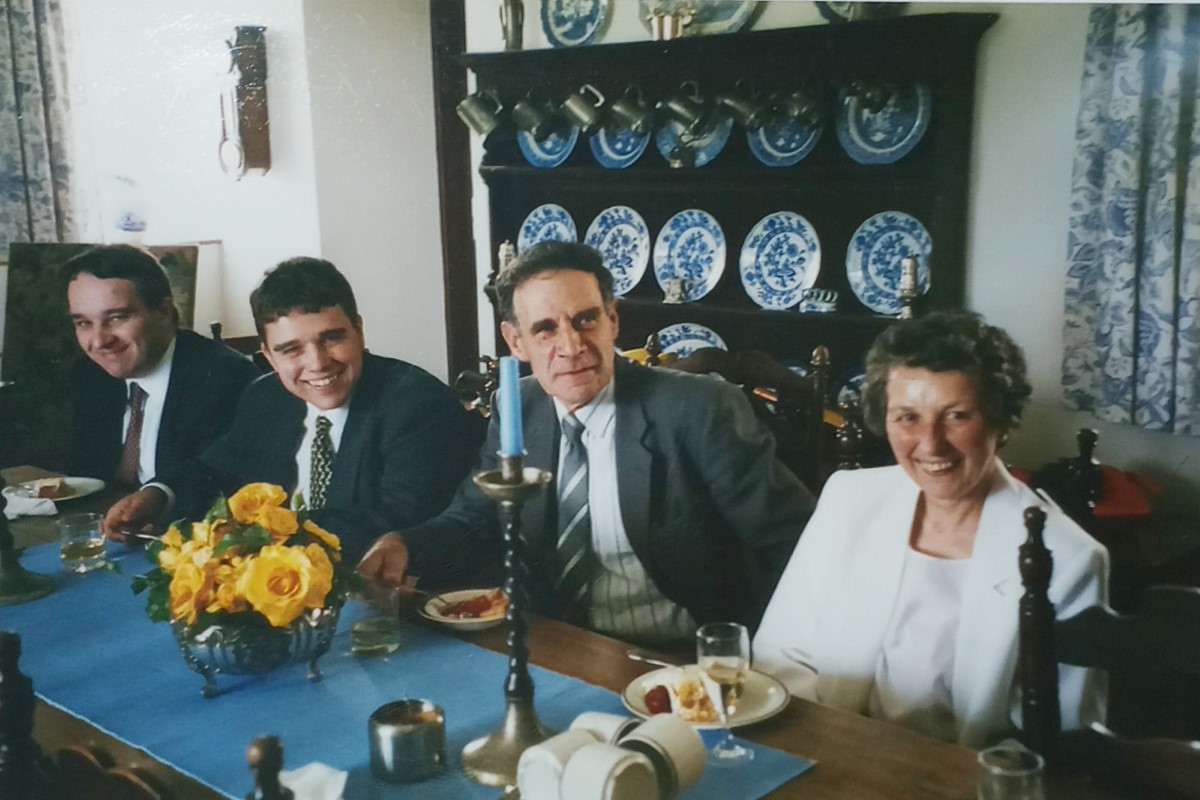
Being able to reconnect and catch up was valued greatly – family visits, kirk Sundays whilst there was still a lower Cabrach kirk, whist drives, Christmas parties, holidays to Skene as a boy, Culrossie above Inverness, Tarland after he got married, marts, shows – places to meet his ain fowk and hae a news. Sitting by the Raeburn at Aldunie after the work was done or the Kirk service was past with a cup of tea (depending on time of day a wee dram for hospitalities sake) surrounded by friends and family was one of his pleasures. A “ca through” o’ the latest developments in fermin’ mixed in with a session of “div ye mine… ?”could keep conversation and laughter flowing uninterrupted for hours and generally only ended when drivers started eyeing the clock and hinting they had a long journey to get hame again – even then newsing generally continued all the way out the door, into the car, windows wound down, engine running and only ended when the car moved away.
Just to clarify for those that aren’t sure of the spelling that’s Rayburn the oil fire, not Raeburn the oil painter, the closest he got to antiques was the roadshow on a Sunday night and the various farm implements that would get hitched to the back o’ the Fordie tractor.
Family was hugely important – his father being one of ten and his mother being one of nine meant that there were many uncles, aunties and cousins and as boys we knew that often as not a summer weekend afternoon out would end up with a visit to one of our many relatives scattered across the North East.
David also took pleasure in welcoming many travellers from all corners of the world seeking a connection with their history and he would do his best to give them a steer as to where their auld fowk would have stayed and the conditions they would have lived in – to his amusement at times when we had to outline that auld hooses didn’t always have running water on tap or indoor toilets, never mind electricity. The connections with the descendants of Davie Sheed in Australia remained strong after 1947 and he was very proud of the success of Davie and his family on the other side of the world. Modern innovations like email and Facebook meant family newsing went global and (notwithstanding time differences) almost instant.
As the family grew up and got their own driving licenses the roles started to alter – they’d do the driving and David would happily sit in the passenger seat and survey the activity in the parks round about – the boys were well used to being told to “dachle a minute” to give him more time to take in what he was seeing.
In 2015 David became a granda for the first time with the arrival of Alexander to Martin and Marianne, and a second time in 2017 with the arrival of Charlie and he took great pride in the boys and all their attempts to help out – byre mucking usually dissolving into an argument over who got to operate the brush – granda would eventually have to step in for the sake of getting his fly fitted in before his supper.
He never really officially retired – he started claiming the pension as was his due but there was no visible evidence of a slowdown. He continued mucking byres, mixing cattle and sheep feed, filling bags, troughing sheep, lambing ewes, calving cows well into his seventies – a level of exertion that would tire a man half his age.
Eventually his body began to signal that he really needed to “ca canny” and a series of episodes meant that his residence in the Cabrach was brought to a stop and he moved home for only the second time in his life to the Speyside Care Home in Aberlour. His mobility had lessened by this point but he was still alert and interested, taking great delight in the activities of the red squirrels that inhabit the surrounding trees and even enjoying a wee hurl in the patient minibus up to Aldunie to once again to do one of his surveys. Sadly latterly his condition failed so he could no longer enjoy these outings but the family were still able to keep him well informed on the news and current affairs.