

- The Cabrach Trust, Inverharroch, Lower Cabrach, AB54 4EU
- Telephone: 01466 702103
- hello@cabrachtrust.org


Cabrach News - 30 September 2021
Andy is one of a growing number of volunteers supporting our activity at The Cabrach Trust. With a particular passion for The Cabrach Royal Observer Corps his insight and knowledge is exemplary. Here Andy talks about one of the many hidden treasures we have at Inverharroch. 30th September 2021 marks 30 years since the ROC post was stood down.
As one travels across the Cabrach it is clear just what a historic landscape it is. The reminders of those who went before are all around. Empty tumbled down cottages and old stone dykes tell of generations winning a living from their beautiful but often harsh surroundings. The memorial cairn to the fallen of the First World War acts a reminder as to one of the reasons that the Cabrach is so empty of people today.
But some historic structures are not so obvious. Not too far from the memorial, sitting high on a rounded hill looking down towards the Grouse Inn there is an almost forgotten reminder of a more recent history. Often confused as being something to do with a local water supply this structure was, up to thirty years ago, one part of Britain’s front line civil defence in the event of thermonuclear war: Post 32.

Post 32 was one of a national network of Nuclear Monitoring Posts, constructed from the mid-1950s into the early 1960s. In this time around 1500 such posts were constructed across the entire length and breadth of the UK, each located approximately 10 to 15 miles apart. With the main body of the structure being hidden underground, all that can be seen above ground is the entrance and forward ventilation shafts, both constructed from reinforced concrete. There are also two metal pipes emerging vertically from below situated between the entrance and ventilation shafts.
The entrance shaft itself is large cube of concrete with a heavy metal lid, once opened a vertical ladder descends into the darkness for some twenty feet. At its foot there is a small cupboard sized room with a larger room approximately 8 by 15 foot leading off to the side. It was in this space that volunteer members of the Royal Observer Corps manning the post carried out the monitoring functions.
Initially known as the Observer Corps the organisation can trace its roots back to World War 1 but was not officially set up until 1925 as a dedicated body providing an inland tracking and reporting function for approaching enemy aircraft. Their contribution in the early days of World War Two led to them gaining their Royal appointment in 1941. At this point in time the ROC operated from above ground observation posts, with sightings and other important information being reported in with the use of telephones. Rapid reporting from the field provided by the ROC allowed effective air raid warnings to be sounded in areas likely to be attacked. However the advent of jet engine technology meant the aircraft being observed were moving so fast that they would have likely reached their target and be heading home by the time any telephone report could be acted on. This along with the development of atomic and then nuclear weapons saw the ROC move from being an above ground observation body to one carrying out an underground based monitoring function as part of the United Kingdom Warning and Monitoring Organisation (UKWMO).
Scotland was split into five main reporting groups, Inverness, Aberdeen, Dundee, Edinburgh and Ayr. Within each Sector each monitoring post belonged to its own ‘cluster’ consisting of three or four posts, one of which was designated as a Master Post. Post 32 was part of a five post cluster including Turriff (Master Post 30 ) Huntly, Post 31, Aberchirder, Post 33 and Banff (Macduff) Post 34. Individual Posts could communicate within their own cluster using telephone lines, the Master Post was equipped with a radio that allowed communications back to the sector’s main command base. Along with the communications equipment each post was equipped with several key items of monitoring devices.
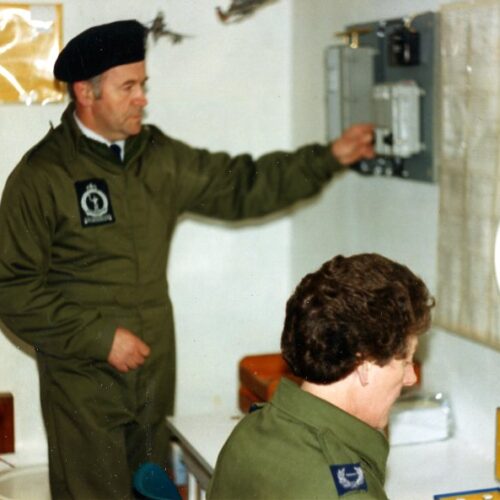
WD1401 Carrier Receiver – This piece of equipment was connected by telephone line to the national early warning system linked into a series of Carrier Control Points, most usually located in police stations across the country. It was this system that would have transmitted the infamous four minute warning. Should the unthinkable happen its regular beep, beep, beep, would change to a continuous tone meaning a nuclear strike was imminent.
Tele Talk – this blue and yellow communications device allowed for communications with other posts using dedicated British Telecom lines.
The Bomb Power Indicator (BPI) – Connected to the smaller of the two metal pipes above ground, this equipment recorded the change in air pressure as the bomb blast passed over the top of the Post and was recorded in Kilopascals on a large clock face like gauge inside the monitoring room. The reading displayed along with the time it was recorded would be communicated back to the cluster Master Post via the Tele Talk, which in turn was then relayed to Sector Command.
Ground Zero Indicator (GZI) – This was a large metal canister fixed to the outside of the entrance shaft. It contained four sheets of light sensitive photo paper. The canister itself had four pin holes in the sides corresponding to the points of the compass. Immediately after the BPI had registered it’s first reading one of the crew would rush up the ladder to retrieve the photo papers. If the flash of the bomb had occurred to the north then that corresponding sheet of paper would have an indication mark on it. Gradient lines on the paper indicated if the bomb had burst above ground level or not. Again this information would be passed back to Sector Command.
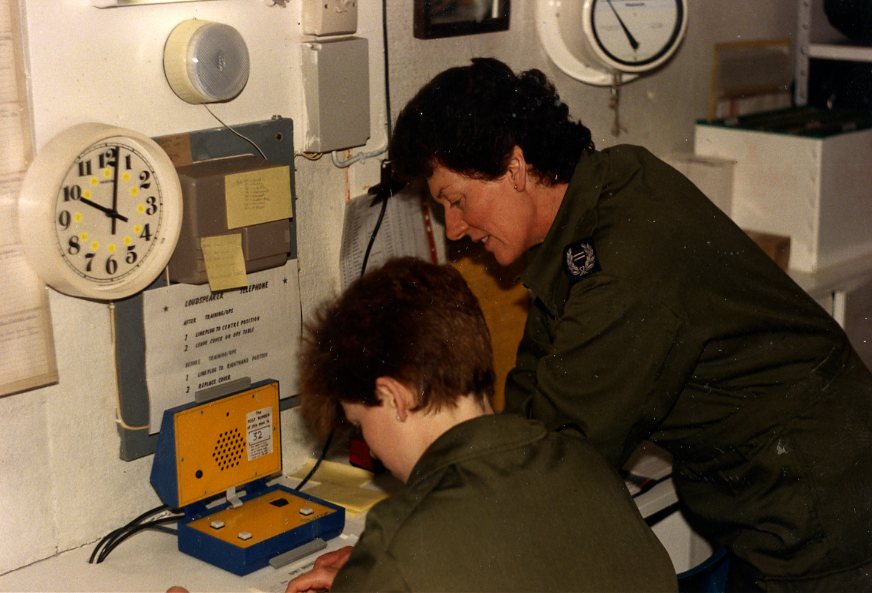
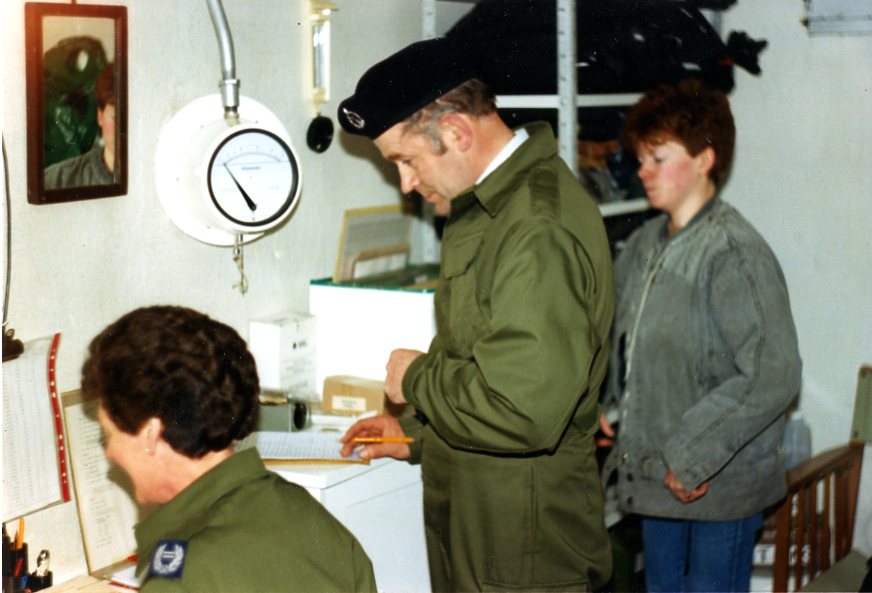
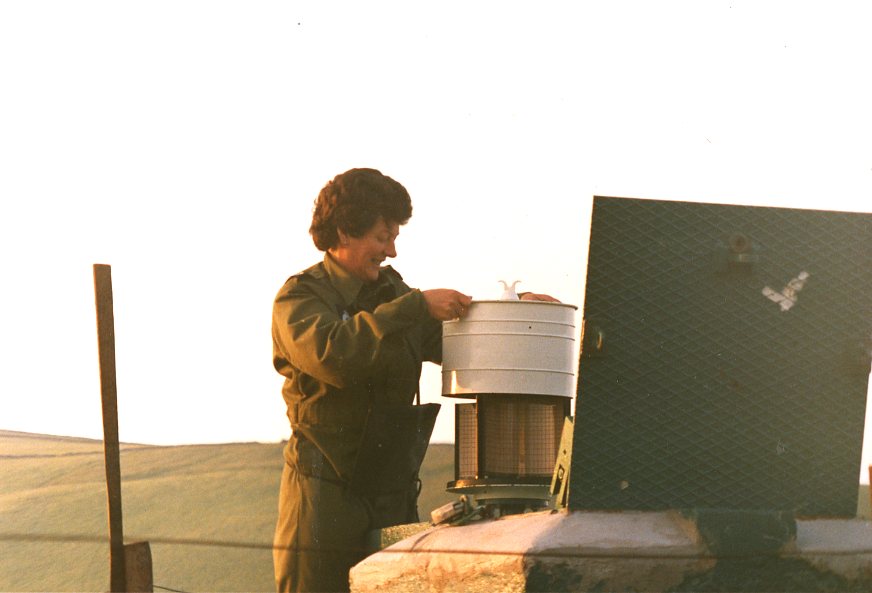
Fixed Survey Monitor (FSM) – This piece of equipment used the larger of the two metal pipes and could detect the levels of radioactive material present outside the post. (Fallout) Readings were taken inside the monitoring room at regular intervals and again reported back to Sector Command
Along with the monitoring function the crew of the Post would also be responsible to warning the local population of approaching fallout by sounding a hand cranked siren or setting off distress maroons.
Accurate and timely reporting was key to the function of the R.O.C. and regular training exercise and courses were held throughout the year. There were also annual examinations to ensure standards were maintained to a high standard.
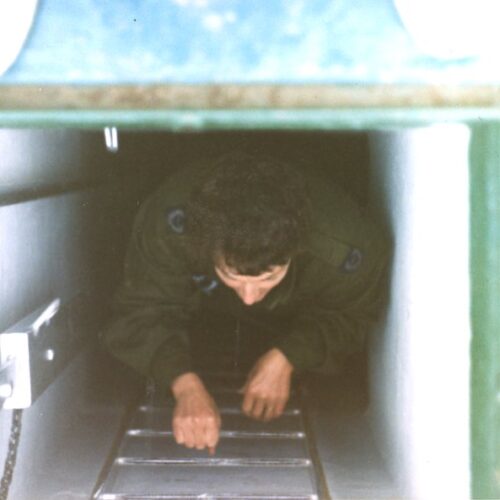
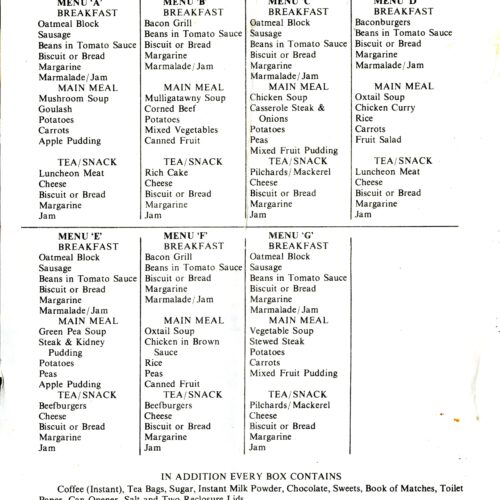
The Posts brought little in the way of home comforts, lighting was supplied by a single 12 volt light bulb powered by a bank of batteries which in turn could be charged up with a petrol generator. Each post had bunk beds and a chemical toilet and carried enough water and food rations to last the crew for up to three weeks. Local woman Margaret Wink, was leading Observer at Post 32 when the ROC were stood down thirty years ago she told me a little about her experiences in the Post.
“The first time I wis in the Cabrach post wis 1985 I think.
Oh!! I wis terrified! I looked doon the hole and seein how far doon you hid tae go, and I saw this ledder…it wisna so bad eence you started doon as you could lean back against the shaft wall. I hid a phobia aboot ledders.”
Then there wis the hole at bottom when you did get doon, there wis a grid on it though. Goin doon the ledder wis jist like goin doon intae a black hole.
There nae heatin, nae facilities, unless ye think a pail served the purpose! I think there wis a chemical but there wis nae wye we were usin’ that!!
We were provided wi long life provisions which we were sure dated back tae WWII. They included tinned goulash, powdered mashed tatties, corned beef, a lump o oatmeal which could be eaten raw or made intae porridge, tinned peaches, chocolate and epple dumplings. Needless to say, we took oor ain supplies! I hid a het watter bottle on ma knees & wore thermal longjohns. There were duffle coats in the post but they were damp and fooshty. I nivver wore one but some o the men did.
Margaret Wink
Despite having to endure the most Spartan of conditions Margaret and her crew took a great pride in the Post and won the R.O.C.’s top post award in 1987 and 1988 plus coming a close second in 1989. She was also diligent in her annual Master Test gaining an intermediate pass in 1986, 1st Class Passes in 1987/88 and 1990 and a Master Pass in 1989.
Although when Margaret initially joined the R.O.C. in 1986 she was the only female member of the crew she was soon joined by her husband Ronnie and two of her daughters, Elaine and Arlene.
Thankfully despite all the meticulous studying, training and practice exercises Margaret and her family never had to carry out their duties in reality and on the 30th of September 1991 she closed the hatch on Post 32 for the last time as at that point the majority of R.O.C. members were stood down and the operations carried out by the network of underground monitoring posts ceased.
Like most of the other Posts the Cabrach was stripped of any equipment considered to be of use or value. However Post 32 was completely stripped out, even the door to the small cubical where the chemical toilet stayed was removed! Some of this equipment can now be seen in the Harold Fraser R.O.C. Room at the Alford Heritage Museum.
I am grateful to Margaret Wink and her daughter Elaine Clarke for their stories and photographs.
News & Events from
Connect with


